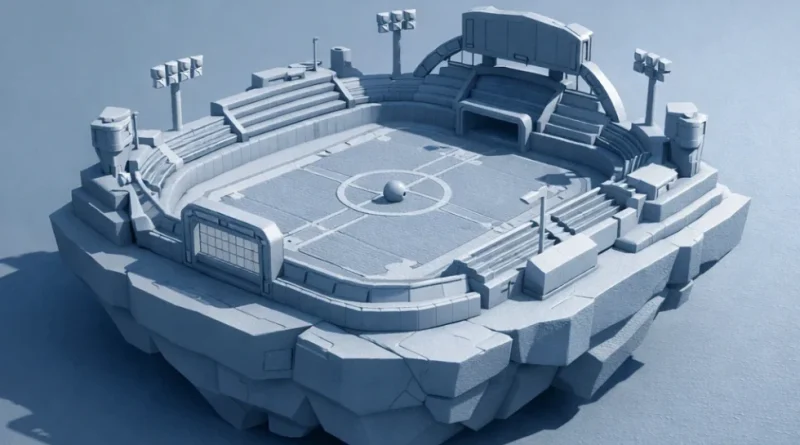
Rocket League Arena — Map / Location Profile: Career Story, Teams and Context
⏱ Estimated reading time: 5 min read
Rocket League arenas at a glance
An arena matters because it is the environment around every Rocket League match: players drive rocket-powered cars, strike a ball and try to send it into the opposing goal area. That basic contest can involve teams of varying sizes, with matches accommodating up to eight players per side in the historical game description available here.
It is tempting to treat every arena discussion as a question of competitive advantage. A more useful starting point is recognition. Arena names help players identify the setting they are seeing, talk about which environments they enjoy, and separate a visual preference from a claim about how a match plays. The supplied information does not establish a full technical definition of shared field features, so there is no basis for treating every visible detail as a confirmed gameplay distinction.
Recognisable Rocket League arena names
Several familiar names are identified as standard arenas in a historical ranking of Rocket League environments: AquaDome, Champions Field, DFH Stadium, Forbidden Temple, Mannfield, Neo Tokyo and Utopia Coliseum.
That is a useful recognition list, particularly when a player wants to put a name to an arena encountered in a match or discussed by the community. It should not be mistaken for a complete catalogue, however. The ranking described a group of 15 contenders as standard arenas, but the material does not establish every name in that group, whether each arena remains available, or which alternate versions may exist.
The practical distinction is straightforward. Use these names as reference points rather than as a definitive answer to “what is in the game now?” A player looking for a particular setting may recognise Neo Tokyo’s name immediately, for example, while someone comparing familiar competitive backdrops may have Champions Field, Mannfield or DFH Stadium in mind. Recognition is valuable; certainty about the live roster requires checking the game itself.
What arena layout means for play
The supported names are described as standard arenas, which gives them a useful common classification. It does not, on its own, prove that every standard arena has identical dimensions, identical layout details or no gameplay-relevant differences. Those specifics are not established here.
For competitive decision-making, avoid building a theory around an arena name alone. The stronger question is whether a setting creates a repeatable condition that changes how players read the ball, position their cars or execute team play. Without confirmed layout information, that question remains open rather than answered. A standard label is a category, not a technical specification.
Using arena preferences
Arena preferences are best treated as a personal-comfort tool: a way to express which environments you would rather encounter. Current menu paths, controls and the precise effect of liking or disliking an arena can change, so confirm those details in your in-game settings before relying on them for match selection.
Choosing an arena approach that suits you
The sensible arena approach starts with separating three different decisions that often get bundled together. First, identify the arena. Second, decide whether you are responding to its look and feel or to a genuine competitive concern. Third, use preference options as a personal setting rather than a substitute for understanding the match itself.
The named arenas provide a workable vocabulary for that first step. AquaDome, Champions Field, DFH Stadium, Forbidden Temple, Mannfield, Neo Tokyo and Utopia Coliseum are all useful names to recognise because they appear in the supported standard-arena material. They are not a complete current list, and they do not settle questions about variants. If the goal is simply to recognise a setting after a match, that limitation is unlikely to matter. If the goal is to track every available arena or find a specific version, the game’s own selection screens are the more reliable place to look.
Next, be precise about what feels different. Visual atmosphere, colour, lighting and familiarity can affect a player’s comfort or concentration without demonstrating a different competitive layout. That does not make the preference trivial. Competitive games are full of small environmental cues, and players naturally develop routines around what they find readable or distracting. The important discipline is not to turn that reaction into an unsupported claim that one standard arena is mechanically larger, smaller or otherwise different.
This distinction also improves team discussion. Instead of saying that an arena caused a poor result, identify the observable problem: missed reads, awkward positioning, rushed challenges or a breakdown in rotation. Those are match issues that can be reviewed and improved. An arena may be the setting in which they happened, but the name alone does not explain the outcome.
Preferences fit at the end of that process. If an environment consistently feels unpleasant or distracting, marking it accordingly may be worthwhile where the current game settings allow it. Just keep expectations proportionate: confirm the available controls and their present selection behaviour in-game, then treat the setting as one part of making your Rocket League experience more comfortable. Arena recognition helps with context; consistent play still comes from the decisions made once the match begins.